Submission
- Description: Go in as much detail as you can about what this project is. Please be as clear as possible!
DESCRIPTION:
Geppetto: Decentralized Accountant with Web 3 embedded
TL;DR
Accountability software system designed for enterprises, entrepreneurs and small businesses alike. The software enables employees, managers and directors to record and track both internal and external transactions or business day to day operations by simply sending messages to a chat.
This innovative program has the ability to understand the information contained in the messages written in natural language, and seamlessly transform it into an accounting entry. How does this work? The program detects the different financial statement accounts, quantities, dollar amounts and types of business transactions/operations from the messages sent. This triggers recording of transactions to the blockchain according to the information given in the accounting entries, and updates financial statements in real time.
Functionalities and Capabilities
Geppetto is an interactive assistant designed to simplify and streamline the way businesses handle their accounting. The interface is reminiscent of a chat between the user and Geppetto, making complex processes feel natural and intuitive.
Recording Transactions: Users can relay transactions that have taken place in real life related to their venture. Geppetto then utilizes this information not only to record the suitable accounting entries onto the blockchain but also to construct comprehensive financial statements according to the International Financial Recording Standards, and to General Accepted Accounting Principles.
Why Geppetto? The Genesis
As entrepreneurs, we’ve tasted the bitter pill of a startup’s demise due to opaque processes and poor accounting management. This issue doesn’t just affect profitability; it creates barriers to financial inclusion. In a world driven by technological advancements, we believed it was time for an even playing field.
Geppetto’s Architecture
DIAGRAMADIAGRAMADIAGRAMADIAGRAMADIAGRAMADIAGRAMADIAGRAMADIAGRAMADIAGRAMADIAGRAMADIAGRAMADIAGRAMADIAGRAMADIAGRAMADIAGRAMADIAGRAMADIAGRAMADIAGRAMADIAGRAMADIAGRAMADIAGRAMADIAGRAMADIAGRAMADIAGRAMADIAGRAMADIAGRAMADIAGRAMADIAGRAMADIAGRAMADIAGRAMADIAGRAMADIAGRAMADIAGRAMADIAGRAMA
The Promise of Decentralized Accounting
Utilizing Smart Contracts, Geppetto establishes decentralized accounting contracts, bringing reliability and transparency to the forefront. Our metric of success aligns with the cost-efficiency principle, emphasizing that accounting costs shouldn’t impede a business’s efficacy. To this end, our modern technological stack leverages L2 EVM-compatible solutions and off-chain decentralized tables, ensuring Geppetto is fast, efficient, and scalable.
Work In Progress
Business Inquiries: A business is a dynamic entity, and stakeholders often need quantitative insights on the fly. Whether it’s inquiring about stock levels or monthly sales metrics, Geppetto is equipped to provide accurate and timely answers. Due to our architecture this is as simple as checking an address (0x…N) balance of our token. Currently we are not displaying it
Dashboard Beyond the chat interface, a visually appealing and insightful dashboard allows users to gauge performance metrics and KPIs. Be it tracking Month-on-Month revenue or understanding sales trends, the dashboard serves as a business’s analytical cockpit.
How it’s made
Tell us about how you built this project; the nitty-gritty details. What technologies did you use? How are they pieced together? If you used any partner technologies, how did it benefit your project? Did you do anything particuarly hacky that’s notable and worth mentioning?
The idea of using the EVM as a State Machine of the firm, as a subset of the State Machine of the world isn’t new, but it hasn’t been exploited due to several factors such as:
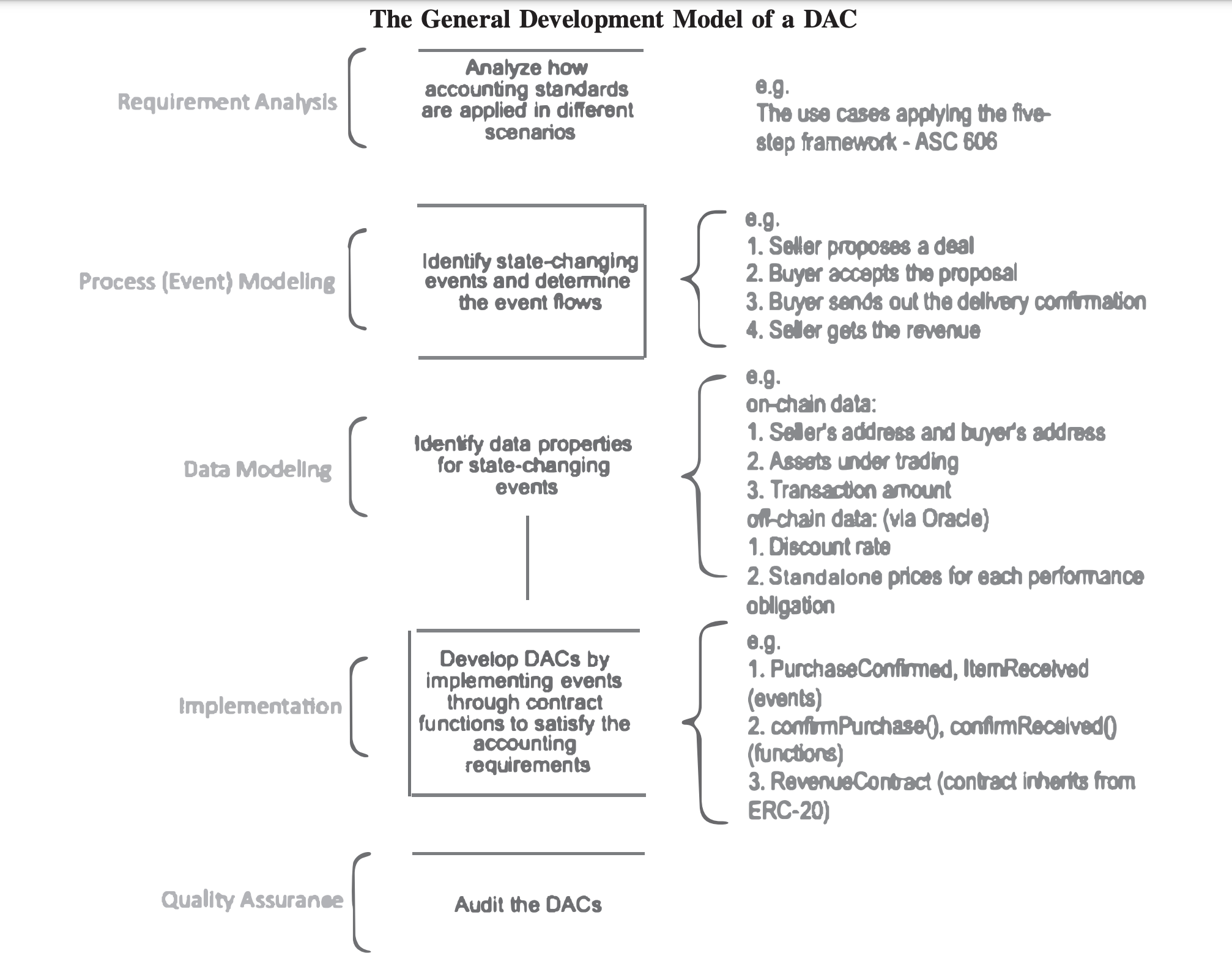
- Accounting can be hard, intricate and elaborate on it’s own. You must adhere to certain principles of recording transactions, and in order for them to be coded they must be exhaustively analized in an algorithmic manner, take for example the review made by Chi- Chun Chou, Taiwei Wang, et. al. in 2021 for American Accounting Association (Journal of Information Systems, vol. 35 no. 3)
- Even if firms can act pseudo-anonymously, it’s important to preserve privacy as this information should not be for public reach if not wanted to. This also leads to the role of permissioning even between firm members.
- There’s a lack of smart contracts that adhere to the accounting standards in a reputable manner.
- Some proponents in the blockchain sphere argue for the use of private blockchains as the solution.
Our approach is different. Instead of using a private blockchain, we leverage several foundational aspects of the EVM, ERC-20, and cryptography to tackle the previously mentioned issues, to ensure privacy, accuracy, and low costs.
Homomorphic Encryption
One of the mainstays of our project is the application of Homomorphic Encryption. This mathematical principle allows for the preservation of sums under elliptical transformation. In simpler terms, it permits the validation of accounting balances without revealing the values of individual transactions. This is depicted in the equation: a + b = c vs Encr(a) + Encr(b) = Encr(c)
Deployment on Mantle
For deployment purposes, we utilize Mantle. It requires a unique identifier that will accompany both the contract and the repository.
Wormhole Messaging
Our journey commences in the abstract chain realm. When there arises a need to send a token to the tangible world — say, a blockchain compatible with ENS, USDC, or another token — Wormhole messaging comes into play.
Workflow
We plan to use a specific diagram as a workflow guide. It’s imperative that we insert an initial step, which will act as an intermediary between the frontend and the interaction with the Tableland contract. This step will:
- Encrypt our entries.
- Formulate the transaction parameters that the Safe will relay on our behalf. This involves a combination of Regular Expressions and a Python handler for account cataloging, which ultimately feeds into the Safe CLI.
For instance: Input: “Purchased 2 Santa Cruz frames, model 9182, for $7,000 and paid with my BBVA card.” Output:
{
C: Inventory (Frames) 7000
D: Accounts Payable (BBVA) 7000
}
XMTP Messaging
Our project also garnered the “Best Encrypted Messages Hack with Lit” prize worth $1,500. It enables sending encrypted messages to email/SMS users using Lit’s “Claimable Keys” feature. The experience is tailored such that a user can securely send a message via AGivenDapp by simply inputting the recipient’s email or phone number.
Tableland Prizes
Our team also participated in the Tableland challenge, where we built and deployed our application using the Tableland Studio web application.
ZK Code Implementation
For the ZK component, we used the Noir library. Our code ensures that double-entry bookkeeping adheres to its primary principle — that debits and credits must always equal each other. We incorporated the Poseidon hash function from the dep::std::hash::posseidon::bn254 library for necessary hashing operations.
Other Collaborations
- Scroll’s Sepolia Testnet.
- Best utilization of Polygon zkEVM.
- Integration with the Safe{Core} Protocol and Safe{Core} Account Abstraction SDK.
In essence, our project brings together diverse technologies to address the twin challenges of permissioning and privacy in blockchain accounting. It’s a harmonious blend of traditional accounting principles with cutting-edge cryptographic techniques, all aimed at ensuring transparency and trustworthiness in the blockchain space.
Also, the user (employee, manager, or director) is enabled to search for data points or specific financial statements in the same way: with natural language sent messages in the chat format. In this way the software will, again, find categorized variables or accounting accounts, the database, or final dashboard and metric and give the output to the user.
Related: What is Geppetto?, Geppetto One Pager, ETH Global NYC, Financial Contracts